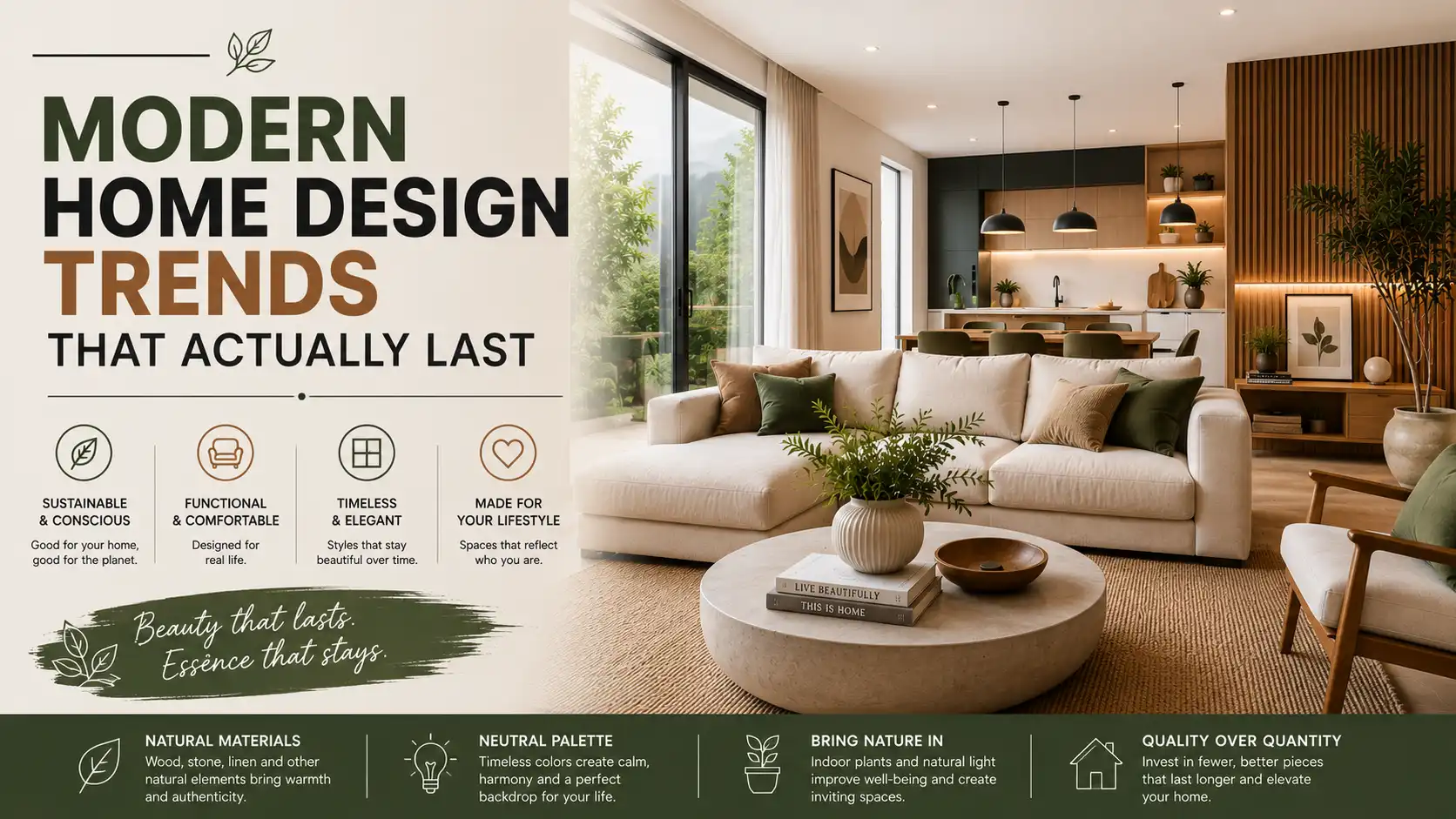
Every few years, a wave of new design trends crashes through the interior world — bold wallpaper, statement ceilings, unexpected color palettes. Some of these ideas are genuinely exciting. Others are forgettable at best and deeply regrettable at worst. The challenge for any homeowner is figuring out which trends are worth investing in and which ones you’ll be ripping out in five years.
The truth is, truly great interior design isn’t about chasing what’s popular right now. It’s about understanding which ideas are rooted in timeless principles — function, proportion, material quality, and human comfort. These are the ideas that survive trend cycles and continue to look fresh decade after decade.
This guide focuses on modern home design trends that have real staying power. These aren’t fleeting fads born from social media virality. They’re design choices grounded in how people actually live, what professional designers return to again and again, and what has proven to age beautifully across different home styles and lifestyles. Whether you’re renovating a single room or rethinking your entire home, the ideas ahead will help you make smarter, longer-lasting decisions.
Why Some Trends Last and Others Don’t
Before diving into specific trends, it helps to understand what separates a lasting design choice from a passing fad. Trends that endure tend to share a few key qualities.
- They solve a real problem. Open floor plans, for example, addressed the isolation of separate formal rooms. Built-in storage addressed the chaos of modern living.
- They connect to nature or comfort. Humans are wired to respond to natural materials, soft light, and tactile texture. Trends that tap into these instincts tend to stick.
- They work across many styles. A trend that only fits ultra-modern or strictly farmhouse aesthetics has a narrow lifespan. Trends that adapt — like neutral palettes or quality wood accents — survive because they’re flexible.
- They age gracefully. Some design elements look better with time — solid hardwood floors, linen upholstery, handmade ceramic pieces. These are investments, not expenses.
Fleeting trends, by contrast, tend to be very specific, very loud, or very tied to a single cultural moment. Millennial pink, the all-white kitchen, or chevron tile — these arrived fast and left just as quickly.
Modern Home Design Trends with Real Staying Power
1. Natural Materials Used Honestly
One of the most consistent threads in long-lasting design is the use of natural materials in their honest, unadorned form. Wood, stone, linen, wool, clay, rattan — these materials have been part of human interiors for centuries because they’re beautiful, tactile, and they improve with age.
The modern version of this trend moves away from faux finishes and overly polished surfaces. Instead, designers embrace the grain in white oak, the variation in marble, the slight irregularity in handmade tile. This isn’t about rustic or farmhouse style specifically — it works equally well in contemporary, Scandinavian, and transitional interiors.
Practical applications include:
- Solid wood cabinetry with a matte or natural oil finish
- Stone or porcelain tile that mimics stone without being fussy
- Linen or cotton upholstery that softens with use
- Exposed wood ceiling beams or structural elements
- Handmade ceramics used as functional tableware and decor
The key is restraint. Pairing two or three natural materials thoughtfully creates more visual impact than layering everything at once.
2. Neutral Palettes with Warm Undertones
The stark, cool-white interiors that defined the early 2010s have largely given way to warmer, more nuanced neutrals. Creamy whites, warm greiges, soft terracotta, earthy taupes, and deep greens are dominating interiors — and for good reason. These tones work with natural light, feel genuinely livable, and provide a backdrop that allows furniture and art to shine.
What makes this a lasting trend rather than a moment is the underlying logic: warm neutrals are forgiving, flexible, and flattering. They work in north-facing and south-facing rooms. They pair with wood tones without clashing. They age without looking dated in the way that a highly specific accent color does.
The best approach is to build a palette around two or three tones — a wall color, a trim color, and a deeper accent — and then bring color in through soft furnishings and artwork that can be changed more easily over time.
3. Purposeful Minimalism
Minimalism as a philosophy — rather than as an aesthetic — has real longevity. The idea is simple: every item in a room should earn its place. This doesn’t mean your home has to look like a showroom. It means clutter is edited thoughtfully and storage is designed into the architecture of the space rather than added as an afterthought.
Purposeful minimalism shows up in design through:
- Built-in shelving and cabinetry that keeps surfaces clear
- Furniture with clean lines and multiple functions
- Fewer, higher-quality decorative objects rather than many mediocre ones
- Intentional negative space — allowing rooms to breathe
Homes that embrace this approach feel calm without feeling cold. They photograph well, they’re easier to clean, and they don’t fall out of fashion because they’re not defined by any single aesthetic movement.
4. Biophilic Design Elements
Biophilic design — the practice of connecting interior spaces to nature — is one of the most research-backed trends in modern architecture and interior design. Studies consistently show that access to natural light, plants, natural materials, and views of greenery reduces stress and improves wellbeing. Design that supports human health is always going to be relevant.
This trend manifests in many ways:
- Maximizing natural light through larger windows, skylights, and glass doors
- Incorporating living plants as a core design element, not an afterthought
- Using organic shapes in furniture and architecture rather than purely geometric forms
- Bringing the outdoors in through courtyard views, garden-facing rooms, and indoor-outdoor flow
- Using water features or natural sounds in spaces where it’s feasible
Even in apartments or small urban homes, biophilic principles can be applied through plant styling, natural light optimization, and the use of organic textures.
5. Layered Lighting Design
Nothing dates a room faster than a single overhead light fixture doing all the work. Layered lighting — combining ambient, task, and accent lighting — is a professional design principle that has been standard practice for decades and shows no signs of changing.
A well-lit room uses:
- Ambient lighting for general illumination (recessed lights, ceiling fixtures)
- Task lighting for functional areas (under-cabinet kitchen lights, reading lamps, desk lights)
- Accent lighting to highlight architectural features or artwork (picture lights, wall sconces, strip lighting inside shelves)
The addition of dimmers to all layers gives homeowners control over mood and function, extending the usefulness of any space from morning to evening.
6. Multifunctional Spaces
The way people use their homes has shifted significantly, and design has followed. Guest rooms double as home offices. Kitchen islands function as homework stations and dinner party bars. Living rooms accommodate movie nights, virtual calls, and exercise sessions.
Smart, multifunctional design is not a trend that will reverse. As homes face upward price pressure and lifestyles continue to diversify, the ability to design a space that serves more than one purpose becomes increasingly valuable.
This shows up in practical choices like:
- Murphy beds with integrated desk systems
- Kitchen islands with seating and storage
- Pocket doors that open or close rooms as needed
- Modular furniture that can be rearranged
- Home office nooks built into bedroom or living room design
7. Quality Over Quantity in Furniture
There’s been a meaningful shift in how thoughtful buyers approach furniture. Rather than filling a room quickly with affordable but disposable pieces, more homeowners are investing in one or two quality anchor pieces and building slowly around them. This is both an economic trend and an environmental one — well-made furniture lasts decades, not years.
The practical advice here is to spend more on the items you use every day (sofa, bed, dining table, desk chair) and save on accessories and accent pieces that are easier to swap out over time.
Design Mistakes That Age Poorly
Understanding what lasts also means recognizing what doesn’t. Common design choices that tend to feel dated within a few years include:
- Overly themed rooms — the nautical bathroom, the fully industrial kitchen. Themes feel clever initially but limit flexibility.
- All-matching furniture sets — buying an entire living room suite from one collection makes rooms look like showrooms rather than lived-in homes.
- Very trendy tile patterns — bold geometric patterns in high-contrast colors can look fresh for two or three years and then start to feel exhausting.
- Painted brick — nearly impossible to undo and often regretted within a decade.
- Open shelving everywhere — a beautiful idea in moderation, but impractical as the primary kitchen storage strategy for most households.
Comparison: Timeless vs. Trend-Driven Choices
| Design Element | Timeless Choice | Trend-Driven Alternative |
|---|---|---|
| Kitchen cabinets | Shaker style in a warm neutral | Ultra-flat, high-gloss in a trendy color |
| Flooring | Wide-plank solid hardwood | Grey laminate with heavy wood grain |
| Wall color | Warm white or earthy greige | Color-of-the-year paint in a bold hue |
| Sofa | Neutral linen or cotton in a classic silhouette | Curved boucle in a statement color |
| Bathroom tile | Subway tile or large-format stone | Patterned cement tile throughout |
| Lighting | Layered with dimmers | Single statement pendant, no dimmer |
How to Blend Trends with Timeless Design
The smartest approach to interior design isn’t to avoid trends entirely — it’s to use them strategically. Here’s how professionals think about it:
- Invest in timeless architecture and fixed elements. Flooring, cabinetry, built-ins, tile work — these are expensive to change. Choose classic materials and proportions here.
- Use trends in soft furnishings and accessories. Cushions, throws, rugs, lamps, and artwork are relatively affordable and easy to swap out. This is where you can play with what’s current.
- Choose one statement trend per room. A room that embraces every current trend becomes exhausting quickly. Pick one — a bold wallpaper, an interesting light fixture, a textured accent wall — and let the rest of the room breathe.
- Buy what you love, not what you’ve seen on Instagram. Truly personal spaces outlast trend cycles because they reflect real taste rather than borrowed aesthetics.
Frequently Asked Questions
What makes a home design trend truly timeless?
Timeless trends tend to be rooted in human comfort, functional logic, and natural materials. They work across different styles and aesthetics, age gracefully, and don’t rely on a specific cultural moment to feel relevant. Classic proportions, quality craftsmanship, and a connection to nature are the hallmarks of design that lasts.
Is minimalism still a relevant design trend?
Yes — but it’s evolved. Pure, stark minimalism has softened into what many designers now call “warm minimalism,” which combines clean lines and intentional editing with natural textures, organic shapes, and layered warmth. This version is more livable and has significantly more staying power than the cold, white-box aesthetic of earlier years.
Should I follow color-of-the-year trends in my home?
The color-of-the-year announcements from brands like Pantone are useful for inspiration but not ideal as the basis for permanent design decisions. If a specific color resonates with you, consider using it in a way that’s easy to change — bedding, cushions, artwork — rather than painting all four walls. Wall color in major spaces is better chosen based on how it works with your specific light conditions and existing elements.
How do I know if a trend will last or fade quickly?
Ask whether the trend solves a real problem, works across multiple styles, and uses materials or principles with proven longevity. Trends born from a very specific moment — a viral social media post, a single celebrity endorsement — tend to burn out quickly. Trends rooted in comfort, function, and quality tend to stick.
What’s the best flooring for long-term value?
Solid hardwood flooring, particularly in wider planks and natural or warm-toned stains, has the strongest track record for long-term appeal and resale value. Porcelain tile in large formats and neutral tones is a close second, particularly for bathrooms and kitchens. Engineered hardwood is also a strong option in spaces prone to humidity or temperature fluctuation.
Are open floor plans going out of style?
Purely open floor plans are being nuanced — rather than fully open spaces, many designers and homeowners now prefer “broken plan” layouts that use partial walls, built-in shelving, or strategic furniture placement to define zones within an open layout. This gives the spaciousness of open design while preserving some acoustic privacy and sense of purpose in each area.
How much should I spend on furniture versus decor?
A common professional guideline is to allocate roughly 70 to 80 percent of your furniture budget to the pieces you use daily — the sofa, dining table, bed, and desk chair — and reserve the remainder for accent pieces and decor. Quality in everyday items pays dividends in comfort and longevity, while accent pieces offer flexibility to refresh a room without major expenditure.
Is biophilic design possible in small apartments?
Absolutely. Even in small or urban spaces, biophilic design can be incorporated through houseplants, maximizing natural light with sheer curtains instead of heavy drapes, choosing natural materials for surfaces and soft furnishings, and using nature-inspired colors — deep greens, earthy browns, warm stone tones. You don’t need a garden view to bring a sense of nature into a home.
Conclusion
The most durable home design choices are almost never the flashiest ones. They’re the decisions rooted in material quality, human comfort, functional intelligence, and a genuine connection to how you actually live. Natural materials, warm neutral palettes, layered lighting, purposeful minimalism, and biophilic design aren’t exciting in the way a trendy wallpaper or a viral paint color might be — but they’re the elements that make a home feel genuinely good to be in, year after year.
The practical next step is to audit your own space: identify the fixed elements that will be expensive or difficult to change, and make sure those are grounded in timeless choices. Then use current trends carefully and strategically in the elements that are easier to update. A room built on a timeless foundation can absorb trend-driven accessories without ever feeling dated — and that’s the sweet spot every thoughtful designer is aiming for.
Related Articles You May Enjoy
- The Psychology of Color in Interior Design
- Small Home Design Ideas That Feel Spacious
- How to Mix Modern and Traditional Decor
- Budget-Friendly Home Decorating Tips
- How to Choose the Right Furniture Scale for Any Room
- Natural Materials in Interior Design: A Practical Guide
- How to Arrange Kids’ Bedroom Furniture for Play and Sleep
 Designing a kid’s bedroom that handles both active play and restful sleep is one of the trickiest… Read more: How to Arrange Kids’ Bedroom Furniture for Play and Sleep
- How to Layout a Pantry for Maximum Storage and Visibility
 Your pantry might be one of the hardest-working rooms in your home, yet it often ends up… Read more: How to Layout a Pantry for Maximum Storage and Visibility
- Space Planning for Pet Owners: Best Layouts for Four-Legged Friends
 Living with pets is a joy—until you trip over a water bowl in the hallway or find… Read more: Space Planning for Pet Owners: Best Layouts for Four-Legged Friends
- How to Layout a Walk-In Pantry and Coffee Bar Combo
 Imagine walking into your pantry, grabbing a bag of freshly roasted beans, brewing your morning espresso, and… Read more: How to Layout a Walk-In Pantry and Coffee Bar Combo
- Space Planning Hacks for Maximizing Vertical Wall Space
 When square footage is tight, the only way to go is up. That’s where space planning hacks… Read more: Space Planning Hacks for Maximizing Vertical Wall Space
- How to Layout a Dream Makeup Vanity and Dressing Area
 Creating a dream makeup vanity and dressing area is about blending function with personal style. Whether you… Read more: How to Layout a Dream Makeup Vanity and Dressing Area
- How to Arrange a Conservatory or Sunroom Layout
 Your conservatory or sunroom has the potential to be the most beloved spot in your home. But… Read more: How to Arrange a Conservatory or Sunroom Layout
- Space Planning for Shared Kids’ Bedrooms That Reduce Bickering
 Sharing a bedroom can be a wonderful lesson in compromise and bonding—or it can be a daily… Read more: Space Planning for Shared Kids’ Bedrooms That Reduce Bickering
- The Secret to Creating Functional Zones in Studio Spaces
 Living in a studio apartment can feel like a constant compromise between style and function. You love… Read more: The Secret to Creating Functional Zones in Studio Spaces
- How to Arrange Furniture in Rooms with Too Many Doors and Windows
 If your living room feels more like a busy hallway than a cozy retreat, you’re not alone.… Read more: How to Arrange Furniture in Rooms with Too Many Doors and Windows
- How to Create a Relaxing Oasis in Your Master Bedroom
 Your master bedroom should be more than just a place to sleep—it should be a personal sanctuary… Read more: How to Create a Relaxing Oasis in Your Master Bedroom
- Sustainable Home Design: Eco-Friendly Materials for Modern Interiors
 Sustainable home design is no longer a niche trend—it’s a responsible lifestyle choice. As we become more… Read more: Sustainable Home Design: Eco-Friendly Materials for Modern Interiors