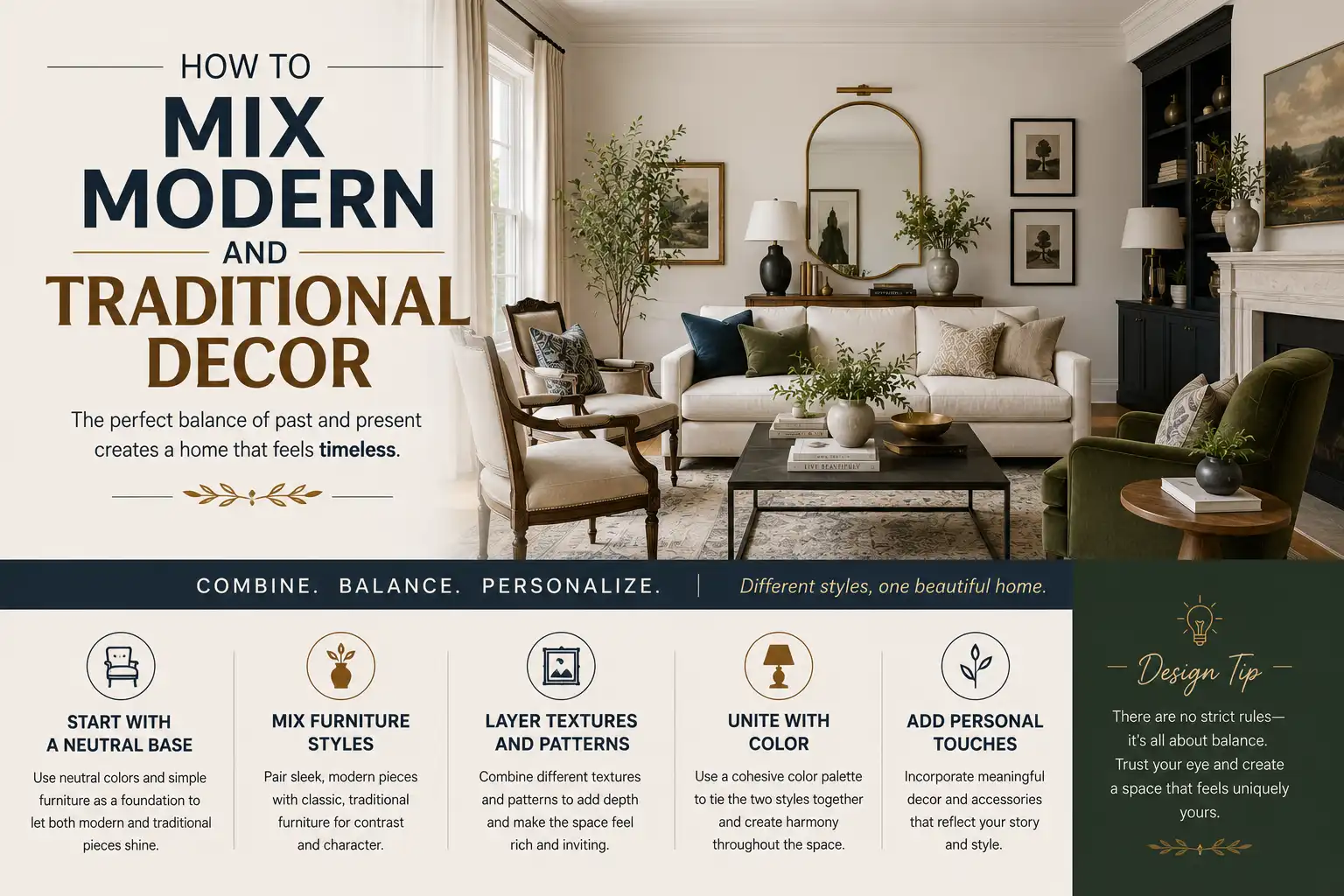
The most interesting homes are rarely decorated in a single, consistent style. The spaces that feel truly personal and alive tend to combine elements from different eras, traditions, and aesthetics — a Victorian chest of drawers beside a clean-lined contemporary sofa, antique Persian rugs on polished concrete floors, grandmother’s oil painting above a minimalist sideboard. These combinations shouldn’t work on paper. In practice, they often create something far more compelling than a room decorated in strict adherence to one style.
Mixing modern and traditional decor is not about ignoring the rules — it’s about understanding them well enough to break them with intention. The difference between a room that looks collected and considered and one that looks confused and accidental is almost entirely a matter of underlying principle. Scale, color, material, visual weight, and intentionality are the tools that make the difference.
Interior designers have long known that mixing styles is the key to spaces that feel genuinely lived-in and personal, rather than like a page from a catalog. This guide breaks down exactly how they do it — the principles, the practical steps, the common mistakes, and the specific combinations that work repeatedly and reliably. Whether you’re furnishing from scratch or incorporating inherited pieces into a contemporary home, what follows will give you the confidence to mix with intention.
Why Mixing Styles Works
To understand why modern and traditional elements work together, it helps to think about what each brings to a space.
Modern design — with its clean lines, minimal ornamentation, and emphasis on function — provides clarity, breathing room, and visual calm. It creates the neutral infrastructure that allows other elements to stand out.
Traditional design brings depth, warmth, craftsmanship, and history. Traditional pieces often have more visual complexity — turned legs, carved details, rich wood tones, ornate patterns — that adds interest and personality to spaces that might otherwise feel sterile.
Together, they balance each other. Modern pieces prevent a traditional room from feeling stuffy or museum-like. Traditional pieces prevent a modern room from feeling cold or impersonal. The combination is, at its best, greater than the sum of its parts.
The Core Principles of Style Mixing
Establish a Dominant Style
The most successful style mixes have a clear dominant aesthetic — roughly 60 to 70 percent of the room leans toward one style — with the contrasting style used as an accent. This prevents visual chaos and gives the room a sense of identity.
Decide first: is this primarily a modern room with traditional accents, or a traditional room updated with modern elements? Both approaches work, but committing to one as the foundation makes every subsequent decision easier.
- Modern-dominant rooms use clean architectural lines, neutral palettes, and contemporary furniture as the base, then introduce traditional elements through rugs, artwork, antiques, and decorative objects
- Traditional-dominant rooms use classic furniture forms, warm wood tones, and layered textiles as the base, then modernize with contemporary art, minimal lighting, and streamlined accent pieces
Find a Unifying Thread
Items that appear to be stylistically different can coexist harmoniously if they share an underlying connection. This is the most important and most underappreciated principle of successful style mixing. The connecting thread might be:
- Color — a warm brass antique lamp and a modern wood-and-brass shelving unit share a material connection that makes them feel related
- Material — a traditional upholstered wingback chair and a contemporary sofa can coexist if both are covered in the same fabric or fabric family
- Proportion and scale — very different pieces that share a similar visual weight read as companions rather than opposites
- Tone — pieces from different eras that share the same warm or cool tone family feel more cohesive than pieces with clashing temperature
Before adding a new piece to a mixed room, ask: what does this share with what’s already here? If the answer is nothing, the piece probably won’t work.
Respect Visual Weight
Every piece of furniture has visual weight — the sense of how heavy or light it reads in the space. A massive Victorian armoire has enormous visual weight; a slim-legged Parsons chair has almost none. Mixing pieces of very different visual weights without balancing them creates a room that feels lopsided and unsettled.
The principle is balance, not symmetry. A heavy antique sideboard can be balanced by a large piece of contemporary art above it, or by two generous upholstered chairs across the room. The weight should feel distributed across the space rather than concentrated in one area.
Use Scale Strategically
Scale is closely related to visual weight but distinct from it. Two pieces can have similar visual weight but very different scales. Scale mixing — pairing a large, grand traditional piece with sleek modern elements — is one of the most effective techniques in eclectic design.
A large, ornate traditional dining table pairs beautifully with contemporary dining chairs. A classic Chesterfield sofa works alongside modern side tables and a minimal coffee table. The contrast between the scales makes both pieces more interesting than they would be surrounded by items of the same period.
Practical Techniques for Mixing Styles
Start with the Rug
A rug is often the easiest starting point for a mixed-style room because it can contain multiple colors, patterns, and references simultaneously. A traditional Persian or Turkish rug in a contemporary room is one of the most classic and enduringly successful style-mixing moves in interior design. The intricate pattern and rich color of a traditional rug brings depth and warmth to a modern space without fighting with clean-lined furniture.
Conversely, a graphic, minimal modern rug in a traditional room provides grounding and visual relief from ornate furniture.
Introduce Traditional Elements Through Antiques and Vintage Pieces
Antiques and vintage pieces are among the most powerful style-mixing tools because they bring genuine history and craft that no contemporary reproduction can replicate. A single good antique in a contemporary room — a 19th century side table, a vintage oil painting, a set of Georgian chairs — elevates the entire space with a sense of authenticity.
You don’t need to be an antiques expert to incorporate vintage pieces successfully. Start with:
- Artwork — old paintings and prints work in almost any style context
- Mirrors — antique or vintage mirrors in ornate frames add character to contemporary spaces
- Lighting — vintage or antique lamps and chandeliers are among the most accessible style-mixing pieces
- Small decorative objects — ceramics, candlesticks, books, and boxes from different eras mix easily on shelves and tabletops
Update Traditional Furniture with Modern Fabric
One of the most cost-effective style-mixing techniques is reupholstering a traditional furniture form in contemporary fabric — or vice versa. A traditional rolled-arm sofa in a sleek performance fabric reads as modern-traditional. A Victorian button-back chair reupholstered in a graphic contemporary print becomes an instantly eclectic statement piece. The traditional form provides structure and history; the contemporary fabric updates it without disguising it.
Mix Metals Intentionally
The old rule that metals must match throughout a room has been abandoned by designers at every level. Mixing metals — brass, chrome, bronze, matte black, copper — creates a much more dynamic and collected look than a monometallic space. The principle is that two or three metals can coexist in a room, but they should be distributed evenly rather than concentrated in one area.
Traditional metals like aged brass and bronze pair well with contemporary spaces. Modern metals like matte black and brushed nickel integrate naturally into traditional rooms. The combination of warm and cool metals in the same space is one of the signatures of sophisticated eclectic design.
Use Art as the Bridge
Artwork is one of the most effective bridging elements between modern and traditional spaces because it operates across all style categories. A large-format contemporary painting above a traditional fireplace creates an immediate and energizing dialogue between eras. A collection of old master prints in a minimal modern room adds depth and context.
Art that contains colors found elsewhere in the room is the most integrating choice — it creates visual connection across different furniture styles and periods.
Room-by-Room Style Mixing Guide
Living Room
The living room is the ideal laboratory for mixing styles because it typically contains the most furniture and the greatest variety of functional requirements. A reliable starting point:
- Contemporary sofa and coffee table (clean-lined, neutral)
- One or two traditional accent chairs (wingback, club chair) in a complementary fabric
- A vintage or antique rug as the anchor
- Contemporary lighting with warm-toned bulbs
- Traditional or vintage artwork framed in a simple, contemporary frame
Dining Room
The dining room offers one of the best opportunities for dramatic style mixing. Traditional and contemporary elements create an interesting tension that’s particularly suited to a social space.
- A large traditional dining table (solid wood, with architectural leg detail) paired with contemporary dining chairs
- Or: a contemporary dining table paired with upholstered traditional dining chairs
- A statement lighting fixture — vintage or contemporary — as the focal point of the room
- A sideboard or credenza in a contrasting style to the table
Bedroom
Bedrooms benefit from a slightly more restrained approach to style mixing — the room should ultimately feel restful and cohesive. A successful mixed bedroom typically has a clear dominant style with accent pieces from the other.
- A contemporary bed frame with traditional nightstands, or vice versa
- Vintage or antique artwork and mirrors as accent pieces
- Layered bedding that mixes modern textured textiles with more traditional printed patterns
Common Mistakes When Mixing Styles
- No dominant style — without one aesthetic holding more weight than the other, a mixed room can feel confused and restless rather than eclectic and collected
- Too many competing focal points — each room should have one clear focal point; multiple competing visual statements exhaust the eye
- Mixing without a unifying color palette — wildly different color temperatures across mixed-style pieces destroy cohesion; settle on a palette first, then choose pieces within it
- All the traditional pieces in one corner and all the modern pieces in another — this creates a divided room rather than a mixed one; distribute contrasting elements throughout the space
- Reproduction traditional pieces rather than genuine antiques — new pieces designed to look old rarely achieve the depth and character of actual vintage or antique items; if the budget allows, one genuine antique is more valuable than ten reproductions
Frequently Asked Questions
How many styles can I mix in one room without it looking chaotic?
In practice, most successful rooms mix two dominant styles — in this case, modern and traditional — with a third subtle reference that adds depth. Mixing three or more strong, defined styles simultaneously makes it very difficult to achieve cohesion. The key is having one dominant aesthetic and one supporting aesthetic, connected by a unifying thread of color, material, or proportion.
Can I mix antique furniture with IKEA pieces?
Yes, and many people do it extremely well. IKEA’s design language tends toward clean, minimal Scandinavian modernism, which is an excellent foil for antique and vintage pieces. The principle is that the antique or vintage piece should be genuinely good — well-made, interesting, with real history — while the IKEA piece provides a neutral, functional backdrop. Mixing a good antique with poor-quality reproductions rarely works, but mixing it with well-designed, honest contemporary pieces works beautifully.
What’s the difference between eclectic and just mismatched?
The difference is intentionality and the presence of a unifying thread. Mismatched rooms have no underlying logic — pieces were assembled without consideration for how they relate to each other. Eclectic rooms have a clear aesthetic personality, a consistent color palette or material thread, and distributed visual weight. Every element in an eclectic room feels chosen; in a mismatched room, elements feel accumulated.
How do I incorporate inherited traditional furniture into a modern home?
Inherited furniture often has significant emotional value, and it can absolutely work in a contemporary home. Start by identifying the piece’s strongest quality — its wood tone, its form, its patina — and build the surrounding context to complement that quality. Reupholstering where necessary to update the fabric while keeping the frame, placing it against a neutral wall to give it space, and pairing it with contemporary pieces that echo its color or material are all effective approaches.
Do I need to hire a designer to mix styles successfully?
No. Understanding a few core principles — dominant style, unifying thread, balanced visual weight — gives any homeowner the foundation to mix styles effectively. The main advantage a professional designer brings is experience with what combinations have worked in the past and a trained eye for when something is slightly off. But the fundamental principles are learnable, and there’s no substitution for trusting your own genuine aesthetic preferences over trying to replicate someone else’s vision.
What architectural styles work best for mixed modern-traditional interiors?
Traditional architecture — crown molding, coffered ceilings, paneled walls, arched doorways — actually provides an excellent backdrop for contemporary furniture because it creates a sense of permanence and history that makes modern pieces look intentional rather than undercontextualized. Conversely, purely contemporary architecture (high ceilings, open plans, minimal detailing) benefits enormously from traditional and antique pieces that add warmth and depth.
How do I mix patterns from different eras and styles?
Pattern mixing across styles follows the same rules as mixing anything else: vary the scale, maintain a consistent color palette, and ensure one pattern is clearly dominant. A large-scale traditional damask or paisley can pair with a small-scale contemporary geometric if both share at least one or two colors. Maintaining no more than three patterns in a single room — one dominant, one secondary, one accent — prevents visual overload.
Is transitional design the same as mixing modern and traditional?
Transitional design is a defined style that deliberately bridges modern and traditional aesthetics — it tends to use classic furniture forms with cleaner lines and simpler details than pure traditional, in neutral palettes that feel contemporary. Mixing modern and traditional is a broader practice that can produce results more eclectic than transitional design, which is more balanced and deliberately middle-of-the-road. Both are valid approaches; transitional design is more accessible and formulaic, while mixing styles leaves more room for personal expression.
Conclusion
Mixing modern and traditional decor is less about following specific rules and more about developing an eye for what connects different elements — the subtle threads of color, material, scale, and weight that allow pieces from different eras and traditions to coexist harmoniously. The most important principle is to make choices deliberately rather than accidentally, to understand the logic behind what you’re putting together rather than hoping it will work by chance.
The practical starting point is to define your dominant style, establish a clear color palette, and identify the connecting thread that will unite your contrasting pieces. From there, begin with the most visible, large-scale elements — the rug, the primary seating, the artwork — and build gradually, stepping back regularly to assess balance and visual weight across the room.
The goal isn’t perfection or catalog-readiness. It’s a space that feels genuinely yours — layered with meaning, interesting to live in, and reflective of a real aesthetic sensibility rather than a single trend or formula.
Related Articles You May Enjoy
- Modern Home Design Trends That Actually Last
- The Psychology of Color in Interior Design
- Small Home Design Ideas That Feel Spacious
- Budget-Friendly Home Decorating Tips
- How to Shop for Antiques as a Beginner
- Transitional Interior Design: The Complete Guide
- How to Arrange Kids’ Bedroom Furniture for Play and Sleep
 Designing a kid’s bedroom that handles both active play and restful sleep is one of the trickiest space… Read more: How to Arrange Kids’ Bedroom Furniture for Play and Sleep
- How to Layout a Pantry for Maximum Storage and Visibility
 Your pantry might be one of the hardest-working rooms in your home, yet it often ends up as… Read more: How to Layout a Pantry for Maximum Storage and Visibility
- Space Planning for Pet Owners: Best Layouts for Four-Legged Friends
 Living with pets is a joy—until you trip over a water bowl in the hallway or find fur… Read more: Space Planning for Pet Owners: Best Layouts for Four-Legged Friends
- How to Layout a Walk-In Pantry and Coffee Bar Combo
 Imagine walking into your pantry, grabbing a bag of freshly roasted beans, brewing your morning espresso, and grabbing… Read more: How to Layout a Walk-In Pantry and Coffee Bar Combo
- Space Planning Hacks for Maximizing Vertical Wall Space
 When square footage is tight, the only way to go is up. That’s where space planning hacks for… Read more: Space Planning Hacks for Maximizing Vertical Wall Space
- How to Layout a Dream Makeup Vanity and Dressing Area
 Creating a dream makeup vanity and dressing area is about blending function with personal style. Whether you are… Read more: How to Layout a Dream Makeup Vanity and Dressing Area
- How to Arrange a Conservatory or Sunroom Layout
 Your conservatory or sunroom has the potential to be the most beloved spot in your home. But without… Read more: How to Arrange a Conservatory or Sunroom Layout
- Space Planning for Shared Kids’ Bedrooms That Reduce Bickering
 Sharing a bedroom can be a wonderful lesson in compromise and bonding—or it can be a daily battle… Read more: Space Planning for Shared Kids’ Bedrooms That Reduce Bickering
- The Secret to Creating Functional Zones in Studio Spaces
 Living in a studio apartment can feel like a constant compromise between style and function. You love the… Read more: The Secret to Creating Functional Zones in Studio Spaces
- How to Arrange Furniture in Rooms with Too Many Doors and Windows
 If your living room feels more like a busy hallway than a cozy retreat, you’re not alone. Rooms… Read more: How to Arrange Furniture in Rooms with Too Many Doors and Windows
- How to Create a Relaxing Oasis in Your Master Bedroom
 Your master bedroom should be more than just a place to sleep—it should be a personal sanctuary where… Read more: How to Create a Relaxing Oasis in Your Master Bedroom
- Sustainable Home Design: Eco-Friendly Materials for Modern Interiors
 Sustainable home design is no longer a niche trend—it’s a responsible lifestyle choice. As we become more aware… Read more: Sustainable Home Design: Eco-Friendly Materials for Modern Interiors