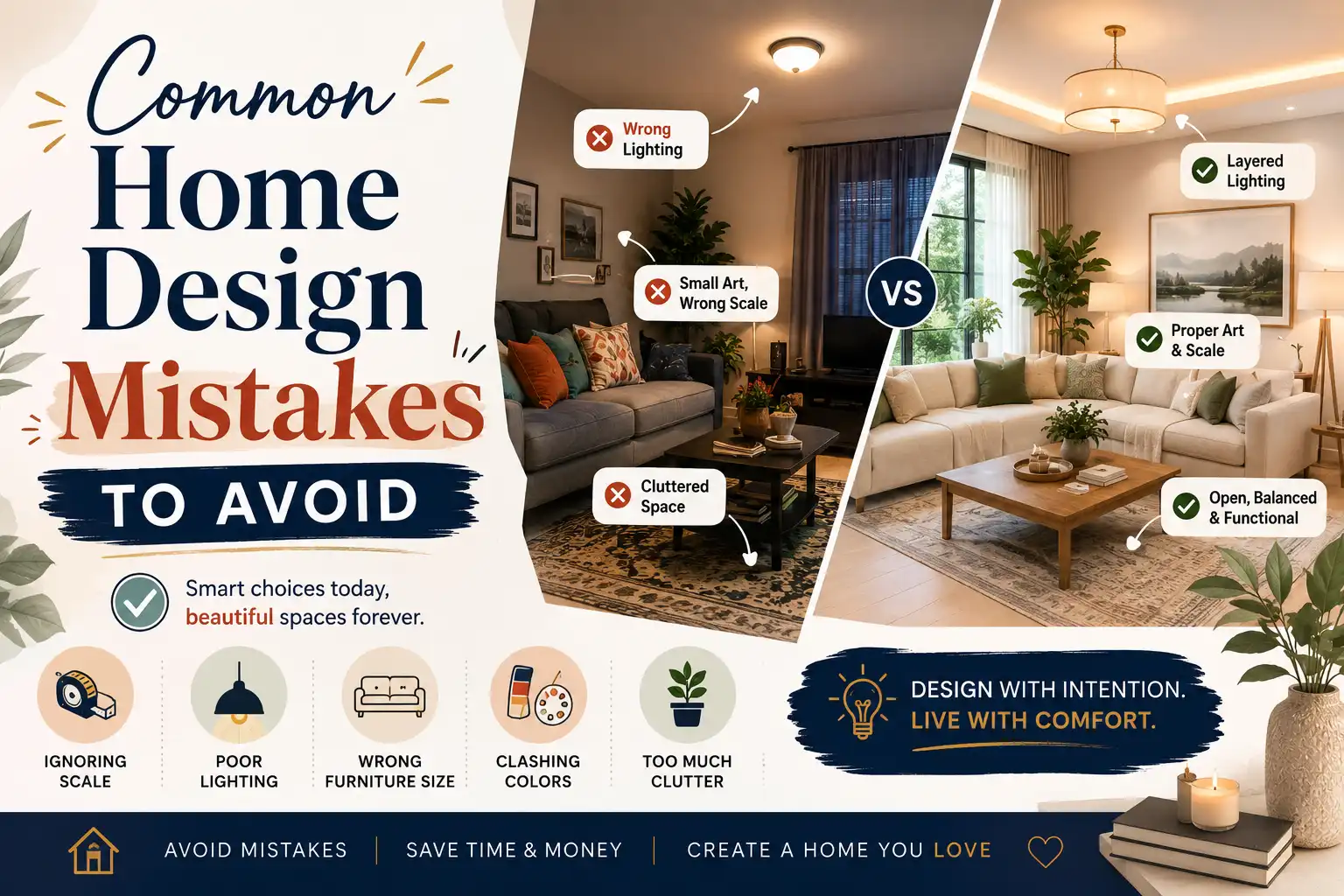
Most home design mistakes aren’t dramatic. They’re small, easy-to-miss choices that quietly make a room feel off, even when you can’t pinpoint why. A couch that’s too big for the space, a rug that’s too small, or lighting that’s too harsh can all undermine an otherwise well-decorated room.
The good news is that most of these mistakes are easy to fix once you know what to look for. You don’t need a full renovation or a professional designer to correct them, just an understanding of a few core design principles.
This guide covers the most common mistakes homeowners make across furniture scale, lighting, color, layout, and decor, along with practical fixes for each. By the end, you’ll have a clear checklist to walk through your own home and spot the issues that might be holding a room back.
Furniture Scale and Placement Mistakes
Buying Furniture That’s the Wrong Size
One of the most common mistakes is choosing furniture based on how it looks in a showroom rather than how it fits the actual room. A sofa that looks modest in a large furniture store can overwhelm a smaller living room.
Fix: Measure your room before shopping, and use painter’s tape on the floor to map out the footprint of larger pieces like sofas and dining tables before committing to a purchase.
Pushing All Furniture Against the Walls
While it seems like it would create more open space, pushing every piece of furniture to the perimeter of a room often makes it feel less inviting and harder to use for conversation.
Fix: Pull seating slightly away from walls and angle pieces toward each other to create a more natural conversational layout.
Ignoring Walkways
Furniture placed without considering traffic flow can make a room feel cramped, even if there’s technically enough space.
Fix: Leave at least 30 to 36 inches of clearance in main walkways.
Lighting Mistakes
Relying on a Single Overhead Fixture
A single ceiling light often creates harsh shadows and uneven brightness across a room.
Fix: Add at least one secondary light source, such as a floor or table lamp, to balance the room.
Choosing the Wrong Bulb Temperature
Cool, bluish bulbs in a living room or bedroom can make a space feel clinical rather than cozy.
Fix: Stick to warm bulbs (2700K–3000K) in relaxing spaces, and reserve cooler bulbs (4000K and above) for task-heavy areas like kitchens and offices.
Color and Paint Mistakes
Choosing Paint Color Without Testing It
Paint colors can look completely different depending on lighting, time of day, and surrounding furniture. A color that looked perfect on a small swatch can feel jarring once it covers an entire wall.
Fix: Paint a sample patch directly on the wall and observe it at different times of day before committing.
Too Many Accent Colors
Using more than two or three accent colors in a single room can create visual chaos rather than interest.
Fix: Stick to a simple palette: one neutral base, one primary accent, and one secondary accent at most.
Rug and Textile Mistakes
Choosing a Rug That’s Too Small
A rug that floats in the middle of a room, with all the furniture around it instead of on it, is one of the most common and most noticeable design mistakes.
Fix: In a living room, the rug should be large enough for at least the front legs of all major seating pieces to rest on it.
Skipping Layers of Texture
Rooms with only smooth, hard surfaces (leather, glass, polished wood) can feel cold and uninviting.
Fix: Add soft textures through rugs, throw pillows, and woven baskets to balance out harder materials.
Wall Decor and Hanging Mistakes
Hanging Art Too High
Art hung at standard “eye level for a tall room” often sits too high for the actual room and furniture below it.
Fix: The center of a piece of art should generally sit around 57 to 60 inches from the floor, or about 6 to 8 inches above a piece of furniture like a sofa or console table.
Leaving Walls Completely Bare
Bare walls can make a room feel unfinished and impersonal, especially in larger rooms.
Fix: Use a gallery wall, a single large art piece, or mirrors to add visual interest without overcrowding the space.
Layout and Flow Mistakes
Designing Around the TV Instead of the Room
Making the television the sole focal point of a living room can limit furniture arrangement and conversation flow.
Fix: Consider angled seating arrangements that allow for both TV viewing and easy conversation, rather than lining everything up in a single row facing the screen.
Ignoring the Room’s Natural Focal Point
Every room has a natural focal point, whether it’s a fireplace, a large window, or an architectural feature. Ignoring it in favor of an arbitrary layout can make the space feel disconnected.
Fix: Identify the room’s strongest feature and arrange furniture to acknowledge it, even if the TV is also present.
Quick Reference: Mistakes and Fixes
| Mistake | Quick Fix |
|---|---|
| Oversized or undersized furniture | Measure room and map furniture footprint before buying |
| Single overhead light | Add lamps or secondary fixtures |
| Untested paint color | Sample on the actual wall first |
| Undersized rug | Size rug so furniture legs rest on it |
| Art hung too high | Center art 57–60 inches from floor |
Frequently Asked Questions
What is the most common home design mistake?
Choosing furniture that’s the wrong scale for the room is one of the most common mistakes, since it’s hard to judge size accurately without measuring beforehand.
How do I know if my rug is too small?
If your furniture sits entirely around the rug rather than partially on it, the rug is likely too small for the space.
Why does my room feel unfinished even with furniture in it?
Bare walls, mismatched lighting temperatures, and a lack of texture are common reasons a furnished room can still feel incomplete.
Is it okay to mix metal finishes in one room?
Yes, mixing metals like brass and matte black can work well as long as one finish is used as the dominant tone and the other as an accent.
How many accent colors should a room have?
A simple rule is one neutral base color plus one or two accent colors, which keeps a room cohesive without feeling flat.
What height should I hang artwork?
Center artwork around 57 to 60 inches from the floor, or just above furniture, rather than at a fixed ceiling-based height.
Should furniture always be against the wall?
No, pulling furniture slightly away from walls and angling it toward other pieces often creates a more comfortable and conversational layout.
Conclusion
Most home design mistakes come down to scale, lighting, and a lack of testing before committing to a choice. By measuring furniture before buying, layering your lighting, sampling paint colors, and sizing rugs correctly, you can avoid the issues that quietly undermine an otherwise well-thought-out room. Walk through your own home with this list in mind, and you’ll likely spot at least one easy fix you can make this weekend.
Related Articles You May Enjoy
- Best Lighting Ideas for Every Room
- How to Design a Relaxing Bedroom Retreat
- Open Concept vs Traditional Layouts
- How to Make a Small Apartment Look Bigger
- How to Arrange Kids’ Bedroom Furniture for Play and Sleep
 Designing a kid’s bedroom that handles both active play and restful sleep is one of the… Read more: How to Arrange Kids’ Bedroom Furniture for Play and Sleep
- How to Layout a Pantry for Maximum Storage and Visibility
 Your pantry might be one of the hardest-working rooms in your home, yet it often ends… Read more: How to Layout a Pantry for Maximum Storage and Visibility
- Space Planning for Pet Owners: Best Layouts for Four-Legged Friends
 Living with pets is a joy—until you trip over a water bowl in the hallway or… Read more: Space Planning for Pet Owners: Best Layouts for Four-Legged Friends
- How to Layout a Walk-In Pantry and Coffee Bar Combo
 Imagine walking into your pantry, grabbing a bag of freshly roasted beans, brewing your morning espresso,… Read more: How to Layout a Walk-In Pantry and Coffee Bar Combo
- Space Planning Hacks for Maximizing Vertical Wall Space
 When square footage is tight, the only way to go is up. That’s where space planning… Read more: Space Planning Hacks for Maximizing Vertical Wall Space
- How to Layout a Dream Makeup Vanity and Dressing Area
 Creating a dream makeup vanity and dressing area is about blending function with personal style. Whether… Read more: How to Layout a Dream Makeup Vanity and Dressing Area
- How to Arrange a Conservatory or Sunroom Layout
 Your conservatory or sunroom has the potential to be the most beloved spot in your home.… Read more: How to Arrange a Conservatory or Sunroom Layout
- Space Planning for Shared Kids’ Bedrooms That Reduce Bickering
 Sharing a bedroom can be a wonderful lesson in compromise and bonding—or it can be a… Read more: Space Planning for Shared Kids’ Bedrooms That Reduce Bickering
- The Secret to Creating Functional Zones in Studio Spaces
 Living in a studio apartment can feel like a constant compromise between style and function. You… Read more: The Secret to Creating Functional Zones in Studio Spaces
- How to Arrange Furniture in Rooms with Too Many Doors and Windows
 If your living room feels more like a busy hallway than a cozy retreat, you’re not… Read more: How to Arrange Furniture in Rooms with Too Many Doors and Windows
- How to Create a Relaxing Oasis in Your Master Bedroom
 Your master bedroom should be more than just a place to sleep—it should be a personal… Read more: How to Create a Relaxing Oasis in Your Master Bedroom
- Sustainable Home Design: Eco-Friendly Materials for Modern Interiors
 Sustainable home design is no longer a niche trend—it’s a responsible lifestyle choice. As we become… Read more: Sustainable Home Design: Eco-Friendly Materials for Modern Interiors