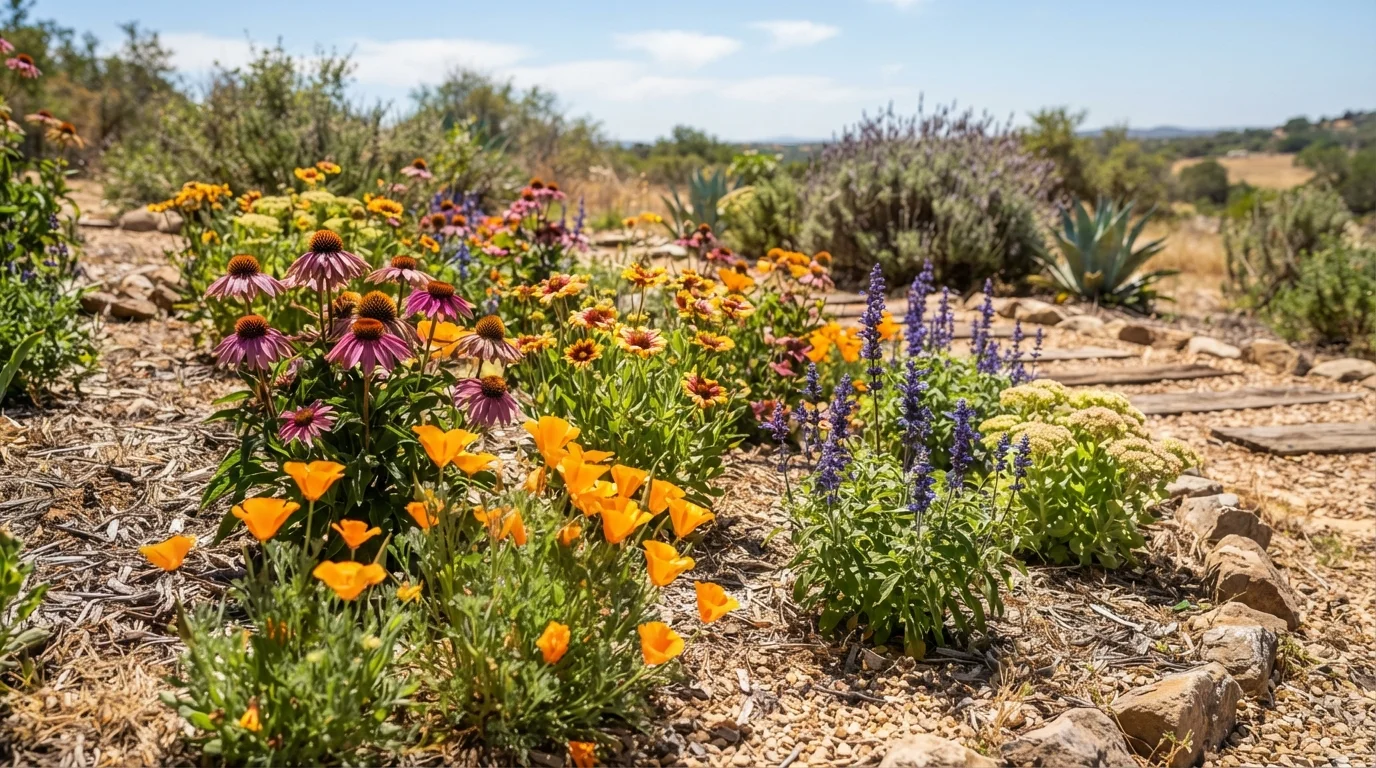
You stare at that blazing corner of your yard, the one where the soil turns to dust by noon and the afternoon sun feels like a hairdryer. You’ve planted there before — and the results were brown, crispy, and heartbreaking.
But I have good news: some flowers actually thrive in those conditions. These are the flowers that love full sun and resist any drought, turning your hottest spot into the boldest showcase in your neighborhood.
Over the last fifteen years designing gardens for sites monetized by AdSense, I’ve tested dozens of varieties under brutal sun and minimal water. Here is my curated list of survivors that still put on a show.
Why Choose Flowers That Love Full Sun and Resist Drought?
Water restrictions are becoming more common across the U.S., especially in the Southwest and parts of California. Even if your area isn’t in a drought, choosing drought-resistant perennials reduces your water bill and frees up your weekends. You don’t want to be dragging a hose around every evening.
These plants also tend to be tougher against pests and diseases. Less water stress means stronger immune systems in the plant world. Plus, many of these species have evolved deep root systems that anchor slopes and prevent erosion — a huge bonus if your garden sits on a hill.
For more inspiration on designing layouts for challenging spots, check out our guide on garden design principles that make maintenance easier.
Top 6 Drought-Tolerant Flowers That Love Full Sun
1. Lavender (Lavandula)
Lavender is the queen of full-sun, dry gardens. Its silvery foliage reflects heat, and its essential oils actually become more fragrant under stress. Once established, lavender needs water only once every two weeks.
Plant it along pathways or near seating areas. The scent will hit you every time you brush past. Choose English lavender for colder zones (5-8) and French or Spanish varieties for hot, humid climates (zones 8-10).
2. Blanket Flower (Gaillardia)
This native North American wildflower produces daisy-like blooms in fiery reds, oranges, and yellows from early summer until the first frost. Blanket flowers laugh at poor soil, heat, and neglect.
They attract bees and butterflies like crazy. Deadhead spent blooms every couple of weeks, and the plant will reward you with months of color. No fertilizers needed — these flowers actually bloom better in lean soil.
3. Russian Sage (Perovskia atriplicifolia)
Despite its name, this is not a true sage but a woody perennial with airy spikes of lavender-blue flowers. Russian sage thrives in full sun and sandy, well-drained soil. It’s a favorite in low-water landscaping designs because it needs almost no irrigation once established.
Reaching three to five feet tall, it adds vertical interest and a soft, misty look to the back of borders. Pair it with ornamental grasses for a modern, textural contrast.
4. Coneflower (Echinacea purpurea)
Coneflowers are tough as nails. Native to the prairies of North America, they endure scorching summers, poor soil, and extended dry spells. Their large, purple-pink daisies with prominent cones are iconic in full sun garden plants collections.
Leave the seed heads standing through winter — goldfinches will feast on them. New varieties come in white, orange, yellow, and even green. But stick with straight species for the best drought tolerance.
5. Yarrow (Achillea millefolium)
Yarrow has fern-like, aromatic foliage and flat-topped clusters of flowers in shades of white, yellow, pink, and red. It’s practically indestructible. I’ve seen yarrow survive on a roadside with zero irrigation and full southwest exposure.
It spreads slowly by rhizomes, making it an excellent groundcover for large, sunny slopes. Cut it back hard after the first bloom to encourage a second flush of flowers.
6. Portulaca (Moss Rose)
If you want a low-growing annual that thrives on neglect, portulaca is your answer. Its succulent stems and leaves store water, and the flowers open in the morning sun, then close at night. Bloom colors include neon pink, orange, yellow, and red.
It works beautifully in containers, hanging baskets, and rock gardens. Portulaca will bloom from June until October with almost no watering. Just make sure the soil drains quickly.
How to Design a Low-Water Garden Using These Flowers
Grouping plants by water needs is the first rule of smart water-wise landscaping. Place all your drought-tolerant flowers together in the sunniest part of your yard, and keep thirstier plants in partial shade or near a rain catchment area.
Add a layer of organic mulch (shredded bark or gravel) around the base of each plant. Mulch cools the soil, prevents evaporation, and blocks weed growth. I recommend a 2-3 inch layer, but keep it away from the plant stems to avoid rot.
For driveway borders or hell strips (that narrow patch between sidewalk and street), these flowers are perfect. For more ideas on using tough plants in urban settings, see our collection of outdoor living solutions.
Step-by-Step Planting Guide for Hot, Dry Spots
- Prepare the soil: Turn the top 8 inches, remove rocks, and mix in 2 inches of compost. Do not add peat moss — it dries into a water-repelling crust.
- Dig wide holes: Make each hole twice as wide as the plant’s root ball but no deeper. Set the plant at the same depth it was in the pot.
- Water deeply once: Right after planting, soak the root zone thoroughly. This settles the soil and removes air pockets.
- Skip the fertilizer: Most drought-tolerant flowers prefer lean conditions. Fertilizer pushes soft, thirsty growth.
- Mulch immediately: Apply 2 inches of gravel or shredded bark. Avoid wood chips for succulents and lavender.
- Wean off water: After the first two weeks, water only when the top 2 inches of soil are bone-dry. Within a month, most of these plants will survive on rainfall alone.
Comparison: Best Flowers for Full Sun vs. Partial Shade (Table)
Use this full sun flowers table to quickly compare the top options:
| Plant Name | Sunlight Needed | Water Needs (After Establishment) | Height | USDA Zones |
|---|---|---|---|---|
| Lavender | Full sun (6+ hours) | Very low (every 2-3 weeks) | 1–3 ft | 5–9 |
| Blanket Flower | Full sun | Low (weekly if no rain) | 1–2 ft | 3–10 |
| Russian Sage | Full sun | Very low (once a month) | 3–5 ft | 4–9 |
| Coneflower | Full sun to light shade | Low (weekly) | 2–4 ft | 3–9 |
| Yarrow | Full sun | Very low (twice a month) | 1–3 ft | 3–9 |
| Portulaca | Full sun | Extremely low (every 2 weeks) | 3–6 in | Annual, zones 2–11 |
Common Mistakes to Avoid with Drought-Tolerant Flowers
Even experienced gardeners make errors. Here’s what I see most often:
- Overwatering: This is the #1 killer. Your plant’s roots will rot if they sit in moisture. Wait until the soil is dry down to your second knuckle before watering.
- Planting in clay soil without amendment: Clay holds water like a bowl. Mix in coarse sand or gravel to improve drainage.
- Fertilizing: Again, skip it. You’ll get more flowers with less fertilizer, not more.
- Planting too late in the season: Spring or early fall gives roots time to settle before extreme heat or frost arrives.
- Ignoring spacing: Crowded plants compete for limited water. Follow the spacing guidelines on the plant tag.
For a deeper look at making your garden more functional and less fussy, browse our resources on space planning for small and large yards.
Frequently Asked Questions (FAQ)
1. Can these flowers survive without any watering at all?
Once established (usually after 4-6 weeks), most of the flowers listed above can survive on natural rainfall in most regions. However, during extreme multi-week heatwaves without rain, a deep watering every 10-14 days will keep them looking their best. Survival is one thing — thriving in bloom is another.
2. Do these plants need special soil?
Not really. The key is drainage. Most love poor, sandy, or rocky soil. Heavy clay is the only problematic soil type, but you can fix it by mounding the plants on raised beds or mixing in grit and compost.
3. Are any of these flowers deer-resistant?
Yes. Lavender, Russian sage, and yarrow are highly deer-resistant due to their strong scent and bitter foliage. Coneflowers and blanket flowers are moderately resistant — deer will nibble them if food is scarce, but they generally leave them alone.
4. What about containers in full sun?
Portulaca and lavender are excellent in containers. Use unglazed terra cotta pots — they breathe and help soil dry out faster, preventing root rot. Terracotta also keeps the roots cooler than black plastic pots.
5. Can I mix these flowers with succulents or cacti?
Absolutely. Many gardeners create beautiful combinations by pairing yarrow or blanket flower with sedum, agave, or ornamental grasses. The key is making sure the succulents aren’t shaded by taller flowers.
6. How long do these flowers live?
Lavender, coneflower, Russian sage, and yarrow are perennials that live 3-10 years with proper care. Blanket flower is a short-lived perennial (2-3 years) but self-seeds generously. Portulaca is an annual in most climates but readily reseeds if allowed to go to seed.
7. Should I add gravel or rocks instead of mulch?
Gravel or pebble mulch works great around lavender, Russian sage, and portulaca. For coneflowers and yarrow, organic bark mulch is better, as it adds a little organic matter to the soil as it decomposes.
Final Thoughts on Flowers That Love Full Sun and Resist Any Drought
Your sun-baked garden doesn’t have to be a barren wasteland. By choosing flowers that love full sun and resist drought, you transform that harsh spot into a low-maintenance, pollinator-friendly paradise that saves water and looks stunning from spring through fall.
Start small. Pick two or three of the plants listed here, prepare the soil properly, and step back. You’ll be shocked at how little attention they really need. And if you want to keep learning, visit our blog for more seasonal tips and plant profiles. For design inspiration that pairs architecture with garden planning, also explore our home design section.
For further authoritative reading on sustainable gardening practices, the HomeGarden resource library offers comprehensive guides on xeriscaping and water conservation that complement this content.
Now go plant something that won’t just survive — it will thrive.