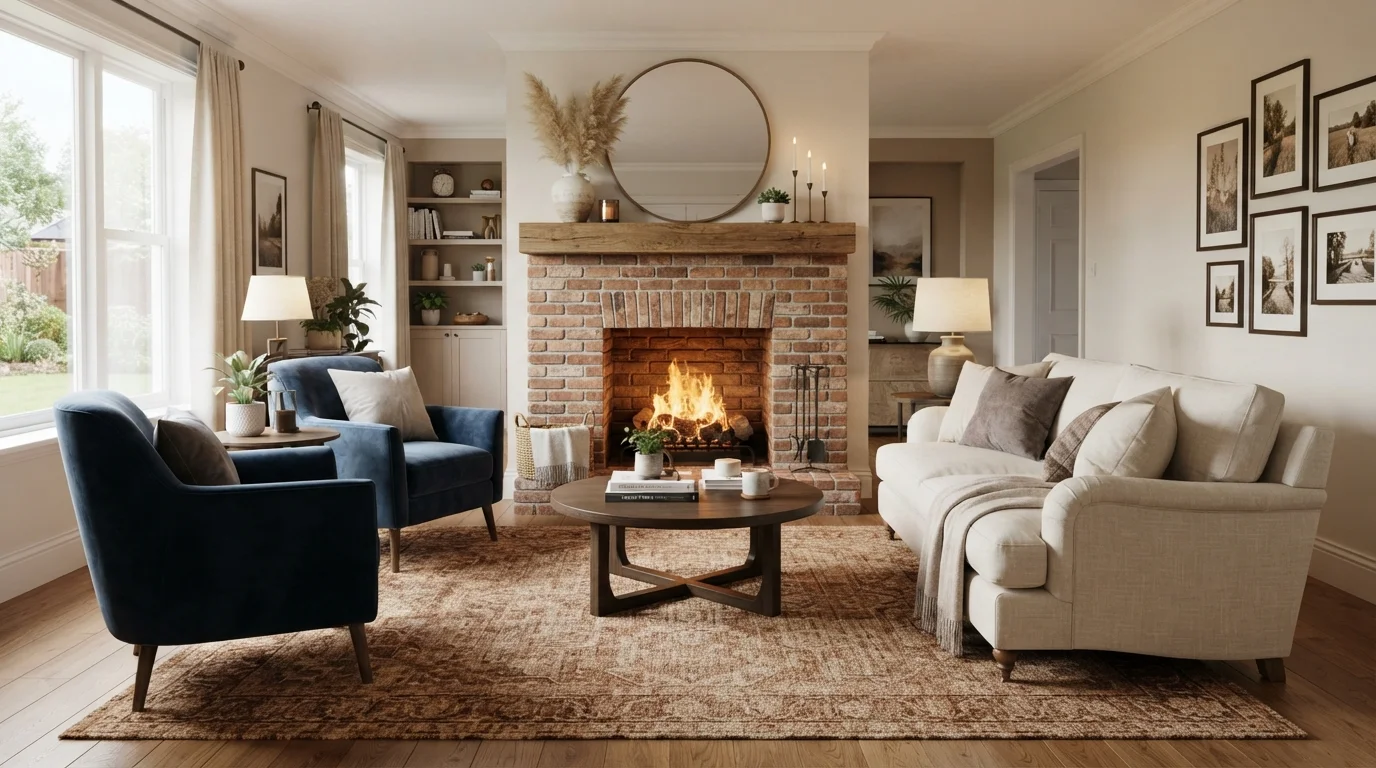
Every great room has a star. Whether it’s a crackling fireplace, a wide bay window, or a statement piece of art, that star is your focal point. But if your furniture doesn’t play along, even the best centerpiece can fall flat.
That’s where arranging furniture around a focal point comes in. It’s the secret sauce that turns a good room into a great one. I’ve spent over a decade helping homeowners crack this code, and today I’m sharing every trick I know.
If you’re tired of rooms that feel awkward or disconnected, you’re in the right place. Let’s walk through the process step by step, with concrete examples you can apply right now.
Why Focal Points Matter in Room Design
A focal point isn’t just a pretty feature—it’s your room’s anchor. It gives the eye a place to rest and creates a natural flow for your furniture layout. Without one, a room feels scattered and unfinished.
Think of it like a conversation. When everyone looks at the same person, the discussion is focused and engaging. Same with a room. When your sofa, chairs, and tables all face or emphasize the same element, the whole space comes together.
For deep space planning insights, remember that every piece you add should relate back to that central feature. That’s the foundation of strong interior design.
Step 1: Identify Your Room’s Natural Focal Point
Not all focal points are created equal. Some are built-in, like a fireplace or a large window. Others are added, like a dramatic piece of art or an oversized mirror. Start by looking at what your room already offers.
If your room has a fireplace, that’s almost always the winner. In living rooms, a TV can also serve as a focal point, though it’s often trickier to balance. In bedrooms, the headboard or a large window with a view usually takes the lead.
Pro tip: avoid competing focal points. If you have a fireplace and a TV on opposite walls, you’ll need to decide which one dominates. Otherwise, your arrangement will feel chaotic. Usually, the larger or more architectural feature wins.
If you’re unsure, check out some room focal point ideas to see how designers handle tricky layouts.
Step 2: Choose Your Furniture Layout Style
Once you’ve locked in your focal point, it’s time to arrange around it. There are three go-to layouts that work for most rooms:
- Symmetrical balance: Perfect for formal spaces. Place identical sofas or chairs on each side of the focal point. Think two armchairs flanking a fireplace.
- Asymmetrical balance: Great for casual, modern rooms. Use different pieces (like a sofa on one side and a pair of chairs on the other) but keep visual weight even.
- Centered anchor: Point all seating directly toward the focal point. Works wonders for media walls or large windows.
Choosing the right style depends on your room size and how you live. A formal living room loves symmetry; a family room thrives on asymmetry.
Step 3: Mind Your Proportions and Scale
The biggest mistake I see? People buy furniture that’s too big or too small for their focal point. A tiny sofa in front of a massive fireplace looks lost. A giant sectional can overwhelm a delicate window.
Here’s a simple rule: your main seating piece should be roughly the same width as your focal point. For a 60-inch fireplace, your sofa should be around 60 to 72 inches wide. Any bigger, and you’ll crowd the space.
To help you visualize, here’s a quick reference table:
| Focal Point Width | Recommended Seating Width | Example Piece |
|---|---|---|
| 48 in (fireplace) | 48–60 in | Small loveseat |
| 72 in (large window) | 72–84 in | Standard 3-seater sofa |
| 96 in (wall art) | 84–96 in | Large sectional (one side) |
Balancing room proportions is key. Leave at least 18 inches between the coffee table and sofa for easy movement. And don’t push everything against the walls—floating furniture creates a cozier feel.
Step 4: Use the Rule of Three for Accessories
Once your big pieces are in place, it’s time to refine. Accessories should reinforce your focal point without stealing the show. The rule of three works wonders here—group items in odd numbers for visual interest.
For a coffee table, place a tray with three candles or a stack of three books. For a mantel, use two matching vases on either side of a central mirror. This creates a natural hierarchy that leads the eye back to the main feature.
If you’re decorating a garden design area near a window, bring in three potted plants of varying heights. It’s the same principle applied outdoors.
Step 5: Create Clear Conversation Zones
Your layout shouldn’t just look good—it should feel good. People need to be able to talk to each other without shouting. That means keeping seating close enough for easy conversation.
Aim for a distance of 4 to 8 feet between seating pieces. Any farther, and you’ll be leaning in. Any closer, and you’re invading personal space. This is especially important when your focal point is a TV or fireplace.
If you have a large room, consider creating multiple zones. Use a rug to define the main seating area, then add a reading nook or a desk farther away. Each zone can still relate to the primary focal point indirectly.
Frequently Asked Questions
What if my room has no obvious focal point?
You can create one. Use a large piece of art, an accent wall with bold paint or wallpaper, or a statement furniture piece like an oversized media console. Even a dramatic light fixture can work.
Can I have two focal points in one room?
Yes, but only if one is clearly primary. For example, a fireplace as the main focal point and a window as a secondary one. Arrange seating to face the primary one, then angle a chair toward the secondary view.
How do I arrange furniture around a corner fireplace?
Use a sectional or a pair of sofas to create an L-shape around the corner. Place a coffee table in the center. Avoid blocking the fireplace with tall furniture—keep it low-profile.
What’s the best layout for a long, narrow room?
Float the sofa parallel to the long wall, facing the focal point at one end. Use two chairs and a small table near the opposite wall to balance the length. Rugs can help define the space.
Does the TV always have to be the focal point?
No. You can hide the TV in a cabinet or use a gallery wall to draw attention away from it. Or arrange seating to face both the TV and a window or fireplace at an angle.
How do I avoid blocking flow to a focal point?
Keep pathways clear. Leave at least 24 to 30 inches of walking space around seating. Avoid placing furniture directly in front of doors or high-traffic areas.
Should I use a rug under my furniture arrangement?
Always. A rug anchors the seating group and makes the focal point feel intentional. Choose a rug large enough that the front legs of all main pieces sit on it. A floating rug looks cheap and unfinished.
For more expert guidance on interior layouts, you might find valuable perspectives from the works of professional home designers—they often share room-specific tips that go beyond the basics.
Conclusion
Arranging furniture around a focal point isn’t complicated, but it does require a plan. Start by identifying that key feature, then choose a layout that suits your room’s shape and your lifestyle. Mind your proportions, use the rule of three for accessories, and always keep conversation zones comfortable.
With these steps, you’ll create a room that feels balanced, intentional, and inviting. Don’t be afraid to experiment—move things around until it clicks. And if you get stuck, revisit your previous design wins for inspiration.
Your focal point is waiting. Now go give it the spotlight it deserves.