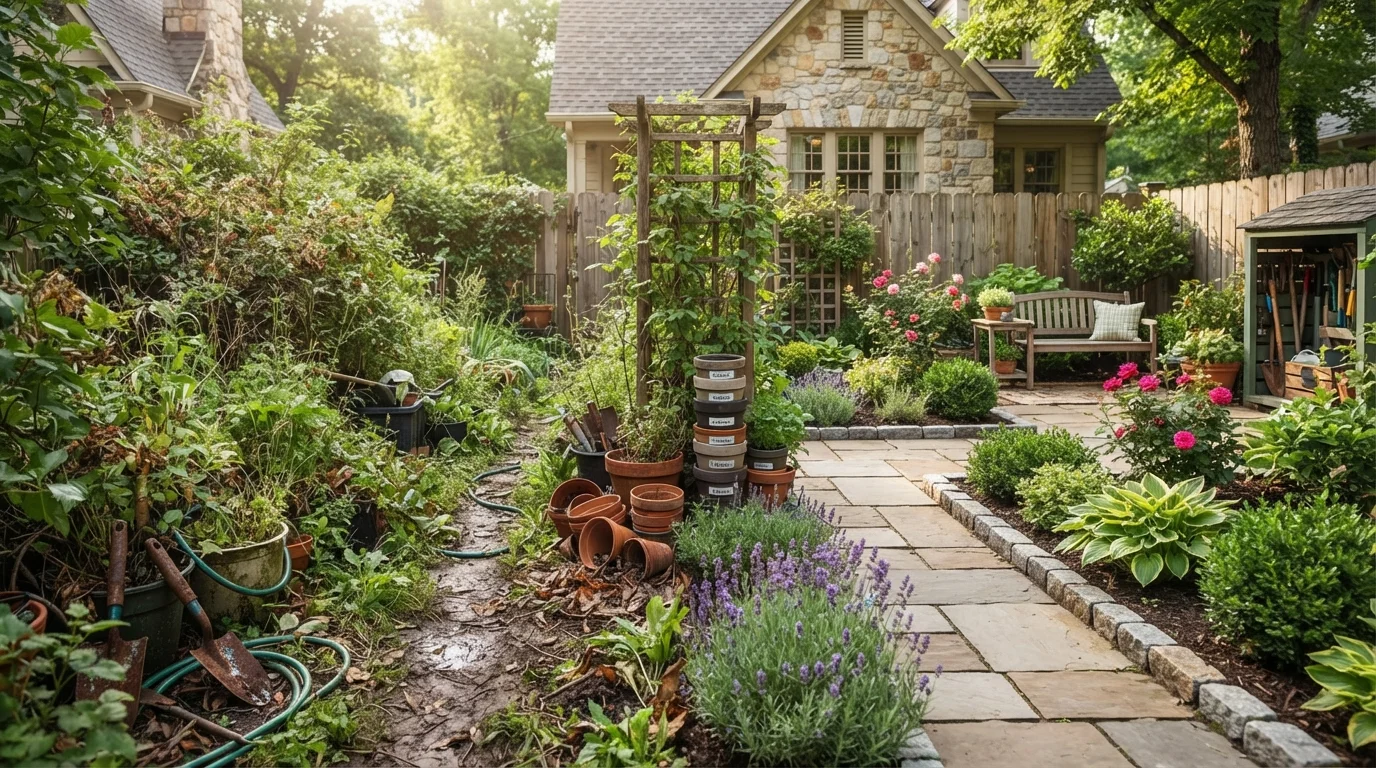
You step into your garden expecting peace, but instead, you feel a twinge of anxiety. There are pots everywhere, a hose snaking across the path, and furniture that looks like it fought a war. You are not alone. A cluttered garden is incredibly common, but the good news is that the fix is often simpler than you think.
Clutter doesn’t just look bad—it makes your outdoor space feel smaller and more stressful. It can even reduce your home’s curb appeal. Let’s unpack the real reasons your garden feels chaotic and, more importantly, walk through the exact steps you can take right now to turn it into a serene sanctuary.
1. You Have Too Many Different Styles (The Visual Noise Problem)
One of the most common garden design mistakes is mixing too many styles in a small area. You might love rustic terracotta, sleek modern planters, and a whimsical fairy garden—all in the same 10-foot space. The result? Visual chaos.
Your eye doesn’t know where to rest. Every element fights for attention. This is the number one reason a garden feels “busy” even when it’s tidy.
How to fix it: Pick a single theme. Choose two or three materials (like wood, stone, and metal) and stick to them. If you love color, limit your plant palette to two complementary hues. This instantly creates cohesion and calm.
For a deeper dive into creating flow between your indoor and outdoor aesthetics, check out our guide on home design principles that apply just as well to the garden.
2. The “More Is Better” Plant Trap
We get it—nurseries are dangerous. You go in for one tomato plant and leave with a cart full of “impulse buys.” But overcrowding plants is a fast track to a cluttered garden fix emergency. Plants that grow too large for their spots block pathways and hide your hardscaping.
An overcrowded bed also invites disease and pests, because air can’t circulate. Suddenly, your garden is not only messy—it’s unhealthy.
How to fix it: Apply the “one-third rule.” Leave at least one-third of each planting bed empty for future growth. Read the mature size on the tag, not the current size. If a shrub will be 4 feet wide, give it 4 feet of space.
3. You Are Storing Things Visibly (The Garden Shed Problem)
Let’s be honest: most of us use the garden as an overflow storage area. The spare folding chairs lean against the fence. The hose sits in a tangled heap by the faucet. The kids’ old sand toys live under the bench. This is the death of a beautiful landscape.
Visible storage screams “clutter” louder than anything else. Your brain registers these items as unfinished business, which creates low-grade stress every time you walk outside.
How to fix it: Invest in a dedicated storage solution. A simple deck box can hide cushions and toys. A hose reel mount on the wall keeps the hose tidy. If you don’t have a shed, consider a small, attractive cabinet or a bench with hidden storage. Good outdoor space organization starts with hiding the utilities.
Learn more about making the most of every inch in our space planning category for outdoor areas.
4. Your Furniture Is Wrong (Scale and Placement)
Giant sectionals in a tiny patio. A tiny bistro set drowning in a massive corner. Wrong scale is a silent clutter creator. Furniture that is too large blocks movement; furniture that is too small looks lost and highlights the emptiness around it.
Both scenarios make the space feel “off.” Your brain interprets that imbalance as messiness.
How to fix it: Measure your space before you buy anything. You need at least 3 feet of walking room around furniture. For a small garden layout, consider folding or stackable pieces. Choose furniture with clean lines and neutral colors—they disappear into the background and let your plants shine.
For inspiration on setting up a cozy outdoor living room, browse our outdoor living ideas.
5. You Are Missing a Clear Focal Point
A cluttered garden often lacks a single “star.” When nothing is the hero, everything tries to be the hero. The result is a jumble. Think of a well-designed room: it has a fireplace or a stunning piece of art. Your garden needs the same.
Without a focal point, your eye wanders without purpose, and it lands on all the little messy details—a dead leaf, a tilted pot, a weed.
How to fix it: Pick one anchor. It could be a beautiful tree, a water feature, a piece of sculpture, or even a brightly painted door at the back of the garden. Position your seating to face this focal point. Everything else should support it, not compete with it.
Looking for a more structured approach? Use this simple table to diagnose the clutter culprits in your own yard:
| Clutter Symptom | Most Likely Cause | Quick Fix |
|---|---|---|
| Too many pots | No unified color scheme | Group pots by color or material |
| Bare soil patches | Overgrown or dead plants | Replace with ground cover or mulch |
| Tangled hoses & tools | No dedicated storage | Install a wall-mounted hose reel |
| Cramped pathways | Furniture too large | Switch to folding or slim pieces |
| Eye doesn’t rest anywhere | Missing focal point | Add a statue, birdbath, or specimen plant |
6. You Are Not Editing Your Accessories
Garden gnomes. Wind chimes. String lights. Solar stakes. Lanterns. Signs. One or two of these is charming. Ten of them is a yard sale. Accessories are the equivalent of the “junk drawer” in your kitchen—they accumulate quietly until they take over.
How to fix it: Implement a strict “one in, one out” rule. Every time you buy a new garden ornament, remove an old one. Keep accessories to a maximum of three per zone. This forces you to choose only the pieces you truly love.
Here are three quick garden decluttering tips you can apply today:
- Do a 15-minute sweep: walk around with a basket and pick up anything that doesn’t belong (empty pots, dead plants, stray toys).
- Group pots by size and color: cluster small pots together and large pots together to create intentional vignettes.
- Edit your plants: remove anything that has died, is diseased, or simply doesn’t spark joy anymore.
If you want to take your garden organization to the next level, many experts recommend using a systematic approach to outdoor space management. A popular resource for this is the Home Garden course, which provides a step-by-step blueprint for transforming chaotic yards into functional, beautiful spaces.
FAQ: Your Cluttered Garden Questions Answered
Why does my garden look messy even after I clean it?
Because cleaning isn’t the same as designing. You likely have too many unrelated elements. The fix is to reduce the number of different materials, colors, and plant types. A minimal palette always looks cleaner.
How do I declutter a very small garden?
Focus on vertical space. Use wall planters, trellises, and hanging baskets. Remove all floor-level clutter like random pots. Choose one or two anchor plants and repeat them. Verticality adds volume without taking up precious floor area.
What is the best way to hide garden tools?
A small shed, a deck box, or a bench with storage inside. If you don’t have space for that, use a decorative screen or a trellis with climbing vines to hide a tool rack. Out of sight, out of mind.
Can too much mulch make a garden look cluttered?
Yes, if you use different colors or textures of mulch throughout the garden. Stick to one type of mulch (like dark brown wood chips) everywhere. It creates a unified base that makes plants pop instead of competing with them.
How many plants is too many for a 10×10 foot garden?
General rule: no more than 5 to 7 distinct plant types, with each planted in groups of three or more. Avoid one-of-each syndrome. Repetition creates calm; randomness creates clutter.
Should I get rid of my garden decor?
Not completely—just be ruthless. Keep only the pieces that are high-quality and meaningful. A single beautiful birdbath is better than ten plastic gnomes. Quality over quantity always wins.
How often should I edit my garden?
Twice a year: once in spring after the last frost, and once in fall before the first frost. Remove dead plants, overgrown shrubs, and any accessories that have faded or broken. Regular editing prevents the clutter from accumulating again.
Does paving reduce garden clutter?
Smart paving can help. If you replace random stepping stones with a consistent paver pattern, it creates a clean canvas. Just be careful not to over-pave—you still need green areas for balance. A unified hardscape reduces visual noise.
Conclusion: Breathe New Life Into Your Garden
Your garden should be your favorite room in the house. It should relax you, not stress you out. By understanding the root causes of clutter—visual noise, overcrowded plants, visible storage, wrong furniture scale, missing focal points, and too many accessories—you can make targeted changes that yield massive results.
Start small. Pick one corner and apply the principles we discussed. You’ll be amazed at how a few intentional edits can transform the entire feel of your space. A peaceful garden isn’t about having less; it’s about having the right things in the right places.
For more detailed inspiration, don’t forget to explore our garden design archives for dozens of other articles that will help you refine your outdoor sanctuary. And if you’re hungry for a broader perspective on home improvement, our main blog is packed with expert advice for every room—including the one outside your door.